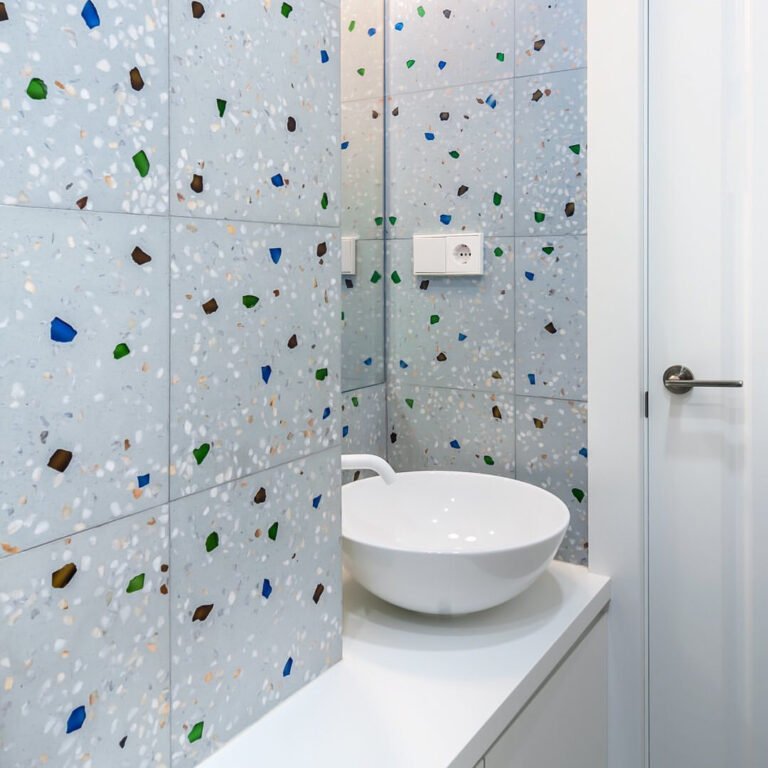

Terrazzo’s beauty usually comes from the random scatter of aggregates—chips of varying sizes naturally suspended in the matrix like an unrepeatable starry sky. But a recent custom product from yuanshen terrazzo takes the opposite approach: it cuts red natural marble into precise square blocks and embeds them in an orderly, grid-like pattern within a warm beige inorganic base. This regular arrangement shifts terrazzo from “natural chance” toward “human order,” offering interior spaces an entirely new visual language.
The body of this Marble square terrazzo is a muted beige, pressed from inorganic cement blended with natural mineral powder. The tone is close to sun-dried clay or aged cotton, providing a clean, grounded foundation. As an inorganic formula free of synthetic resin, it carries a Class A fire rating, with a compact structure and low water absorption. According to industry technical specifications, quality terrazzo aggregate should demonstrate a 24-hour absorption rate below 0.75% and abrasion resistance loss under 40% per ASTM C 131 standards. This marble square terrazzo undergoes corresponding testing before leaving the factory to ensure stable physical performance.


What truly distinguishes it from ordinary terrazzo is the form and layout of its aggregate. Red natural marble is precision-cut into uniform square blocks, not scattered randomly but arranged according to preset spacing and angles. This design approach belongs to the geometric pattern system within the terrazzo industry—controlling aggregate shape and position to create surface rhythms reminiscent of woven textures or checkerboard grids. Each red square retains the subtle veining and color variation inherent to natural marble, embedded in the beige cement paste to create a contrast between rigid stone and soft matrix.
From a materials science perspective, square aggregate offers greater surface contact area with the cement matrix than round or irregular chips, meaning stronger mechanical bonding and more stable long-term performance. As the binder hydrates, it forms a dense interfacial layer around each block, locking the red marble squares firmly into the panel body. According to technical data from the National Terrazzo & Mosaic Association (NTMA), traditional cement terrazzo formulations can accommodate various aggregate sizes, while regular-shaped chips distribute compression forces more evenly during pressing, yielding higher surface flatness in the finished product.
In residential interiors, this marble square terrazzo performs exceptionally well. Used for living-room floors, the beige base keeps the space feeling bright and warm, while the red squares act like pieces on a chessboard, breaking monotony with steady rhythm without the visual clutter of random chips. In an entryway, the regular geometric pattern establishes a sense of order from the first step inside. Because it is an inorganic formula containing no volatile organic compounds, homeowners need not worry about harmful emissions from underfloor heating. A factory-applied surface sealer prevents daily dust and stains from penetrating, making it family-friendly—spilled drinks wipe away with a damp cloth.

In restaurants and commercial dining spaces, the advantages of this marble square terrazzo become even more pronounced. The food-service industry demands floors that are oil-resistant, abrasion-resistant, easy to clean, and visually compelling. Cement-based terrazzo offers excellent stain resistance and naturally slip-resistant texture, while the regularly arranged red squares give diners a memorable environment. For a design-conscious café or Western restaurant, this geometrically ordered floor enters a material dialogue with wooden furniture and metal lighting fixtures. In hotel lobbies or brand showrooms, the regular red grid across the beige field projects professionalism and design intent, maintaining visual control even across large installations where random aggregate might feel chaotic.
From a sustainability standpoint, this marble square terrazzo also holds its ground. The red marble squares are cut from natural stone processing offcuts and repurposed through precision cutting, reducing the need to quarry full blocks. The inorganic cement matrix releases no volatile organic compounds, contributing to healthier indoor air. And terrazzo’s industry-recognized longevity—with proper maintenance, floors can last for decades—means it does not become construction waste on a regular replacement cycle.

Installation follows standard stone procedures. This marble square terrazzo can be cut and drilled like conventional stone, set with ordinary cement mortar wet-lay methods without special techniques or additional crew training. For richer visual effects, the spacing, angle, or size of the squares can be adjusted to create custom variations. Daily maintenance requires only neutral pH cleaner and a damp mop.
In summary, this custom marble square terrazzo from yuanshen terrazzo uses a beige inorganic base to support orderly arranged red marble squares, finding a balance between natural material and human geometry. It suits homes that want warmth and geometric beauty, as well as dining venues that need durability and personality. For project teams seeking a surface that is classic yet never ordinary, this Marble square terrazzo is a choice worth serious consideration.
If you are looking for inspiration for interior design materials, consider trying terrazzo. You can contact us to learn more about customized terrazzo, or order a terrazzo sample to add more diverse, vibrant, and eco-friendly elements to your home.